A small gift brand built its site for AI search, with llms.txt, open crawlers and plain prices, yet doesn't show up in buyer searches. Here's why.
Short answer: a small brand can do everything right on its own website and still be missing from AI answers. Song Tailor, a custom song gift service, is a clear example. Its site is fully open to AI crawlers, publishes llms.txt files and states its prices in plain text. Yet in buyer searches for its category, it doesn't show up. The gap isn't on the site. It's everywhere else.
We looked at Song Tailor from the outside, using only what anyone can see: its public files, its pages, its profiles and live search results. Here is what we found, why it matters, and a checklist you can run on your own brand.
The brand: a young business in a crowded category
Song Tailor turns a customer's story into a personalized song for an anniversary, birthday, wedding or other occasion. Its pricing page lists three tiers: $39 with 48-hour delivery, $89 with 1-hour delivery and one guided revision, and $149 and up with 1-hour delivery and unlimited revisions for a week.
The category is crowded. Search for custom songs and you'll find established services with years of press, thousands of reviews and a place in gift guides, plus hundreds of freelance sellers on marketplaces. Song Tailor's Product Hunt page says it launched in 2026.
That makes it a useful test case. For "which service should I use?" prompts, AI engines name only a handful of brands. Can a newcomer earn one of those spots with on-site work alone?
On site: almost everything an AI engine wants
Song Tailor's public files and pages tick nearly every box in the usual AI-readiness checklist.
- AI crawlers are explicitly welcome. Its robots.txt has named rules allowing GPTBot, OAI-SearchBot, ClaudeBot, PerplexityBot and Google-Extended. Only checkout and account paths are blocked.
- Machine-readable summaries. It publishes an llms.txt file listing its key pages, a longer llms-full.txt with a "Key Facts for Citation" section, and a plain-text pricing.md file.
- Content in the HTML. The homepage headings, tier cards and FAQ answers all arrive in the initial page response. Nothing important waits on JavaScript.
- Prices in plain text, near the top. The pricing page opens with "Three levels of care, starting at $39." An assistant asked about cost can quote that directly.
- Headings phrased like prompts. The pricing page has 11 question headings, such as "How much does a custom song cost from Song Tailor?" and "Can I get a custom song for under $50?". The homepage FAQ even includes "What company makes personalized songs?", which is exactly how people phrase the question to a chatbot.
This matches Google's own guidance on AI features and your website: crawlable pages, important content in text, and clear answers. In DeepLexa's terms, Song Tailor has solved retrievability. If an AI system goes looking for a custom song service's prices, this site makes them easy to fetch and quote.
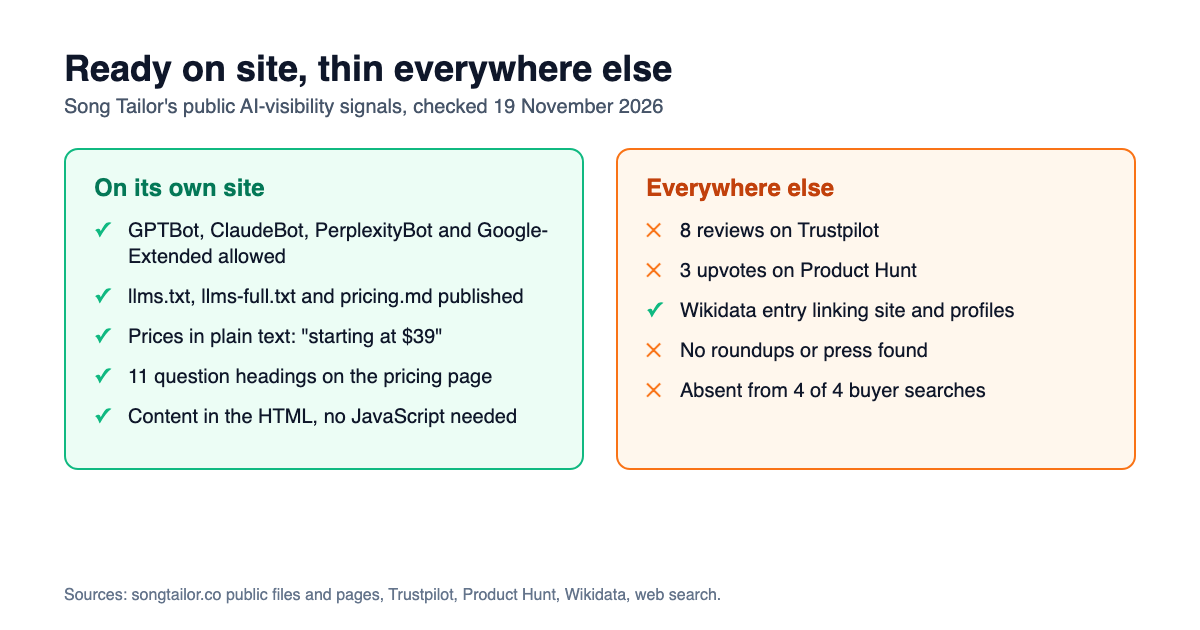
Song Tailor's public footprint on 19 November 2026: ready on site, thin everywhere else.
Off site: almost nothing to back it up
Then we looked at what the rest of the web says about Song Tailor. AI engines draw heavily on this when they decide whom to recommend.
- Reviews: 8 reviews on Trustpilot, on a profile claimed in August 2026.
- Launch platforms: a Product Hunt listing with 3 upvotes.
- Knowledge graph: a Wikidata entry that describes it as a "custom song gifting service" and links its official site and social profiles. That's a good start, and a step many small brands skip.
- Roundups and press: none we could find.
Search results show what that means in practice. On 19 November 2026 we ran four buyer searches: "best custom song service 2026", "how much does a custom song cost", "personalized song gift for anniversary" and "custom song gift with 1 hour delivery". Song Tailor didn't appear in any of them. A search for its own name in quotes surfaced a Product Hunt tracker page and little else.
The searches also show who does appear:
- Vendors that publish their own comparisons. The top result for "best custom song service 2026" was a competing vendor's "honest comparison" article, and the same vendor's guides took several more spots.
- Review platforms. Trustpilot pages for established competitors appeared directly in the results for a "best" query.
- Brands with press. For the one-hour-delivery search, the result was a rival offering the same turnaround, backed by a gift write-up on a national news site. Song Tailor offers one-hour delivery on two of its three tiers, but nothing outside its own site says so.
Those are the sources AI engines pull from when they answer "which service should I use?". This is the pattern behind why competitors get named in AI answers instead of you: a brand's own pages can explain what it sells, but they can't vouch for it. The research paper that coined the term generative engine optimization made a related point: whether generative engines surface a source depends on more than relevance.
Four lessons for small brands
1. On-site readiness is necessary, not sufficient
Song Tailor shows that a small team can get technical AI readiness right in its first few months. That work makes the brand quotable for factual questions, like price, delivery and how it works. It does not make the brand recommendable for "best" questions. Treat the on-site work as the entry ticket, not the finish line.
2. Your facts must agree everywhere
When a brand publishes the same facts in several places (pages, schema, llms.txt, pricing files and review profiles), they all have to match. If the homepage shows one rating and a review platform shows another, or an old summary file still carries last quarter's review count, an AI system may trust neither number. Audit every place a key fact appears, and update llms.txt in the same change as the page it summarizes.
3. Get onto the pages that already rank
The searches above show which pages AI engines are likely to draw on: comparison articles, gift guides and review platform pages. For a small brand, the fastest route into AI answers is usually being added to pages that already rank: reviews from real customers on third-party platforms, and inclusion in existing roundups. Building new pages comes later.
4. Make your best feature visible off site
Song Tailor's one-hour delivery is a real differentiator, but only its own site mentions it. A rival with the same feature and one press mention takes the search. If a feature is your reason to be recommended, it has to appear in the places assistants read, in words a writer or reviewer would actually use.
A checklist you can run in an afternoon
| Check | How to do it | What good looks like |
|---|---|---|
| AI crawler access | Open yoursite.com/robots.txt | GPTBot, OAI-SearchBot, ClaudeBot, PerplexityBot and Google-Extended not blocked |
| Content in HTML | View page source on your pricing page | Prices and answers visible without JavaScript |
| Answer-ready pages | Read the first sentence under each heading | It answers the heading's question on its own |
| Fact consistency | Compare rating, price and counts across pages, llms.txt and review sites | One number for each fact, everywhere |
| Off-site proof | Search your category's "best X" and "X cost" queries | Your brand on at least one result you don't own |
| AI answers | Ask ChatGPT, Perplexity and Gemini your buyers' top 10 questions | Named for the questions you can honestly win |
Frequently asked questions
Can a small brand get recommended by ChatGPT?
For factual questions, yes: a clear pricing page can be quoted from day one. For "which is best?" questions, AI engines lean on independent sources, so a small brand needs reviews and third-party mentions before it shows up there.
Does an llms.txt file help?
It makes your key pages and facts easy for AI systems to find. It doesn't create authority, and a stale one can spread outdated numbers, so update it whenever a key fact changes.
Is a Wikidata entry worth creating?
It helps AI systems connect your brand name, website and social profiles as one entity. It's a small step, but it won't make you recommended on its own.
How long does it take to close the off-site gap?
Technical fixes can show up within weeks. Reviews and mentions build over months. We cover realistic timelines in how long until your AI visibility actually improves.
Find out where your brand stands
Song Tailor's position is common: ready on site, nearly invisible off it. The first step is knowing which buyer prompts name you, which name your competitors, and which sources those answers rely on. Run a free AI visibility check to see where your brand shows up in ChatGPT, Perplexity, Gemini and Google AI Overviews.
All facts in this article come from public sources (Song Tailor's website and public files, Trustpilot, Product Hunt, Wikidata and web search results) and were checked on 19 November 2026. Search results vary by engine, location and date. Disclosure: Song Tailor and DeepLexa are both run by Bravos AI.
See it for your brand
Want to know if ChatGPT, Perplexity and Google AI recommend you? Run a free instant AI visibility check — no signup, ~30 seconds.
Get your free AI visibility report →